
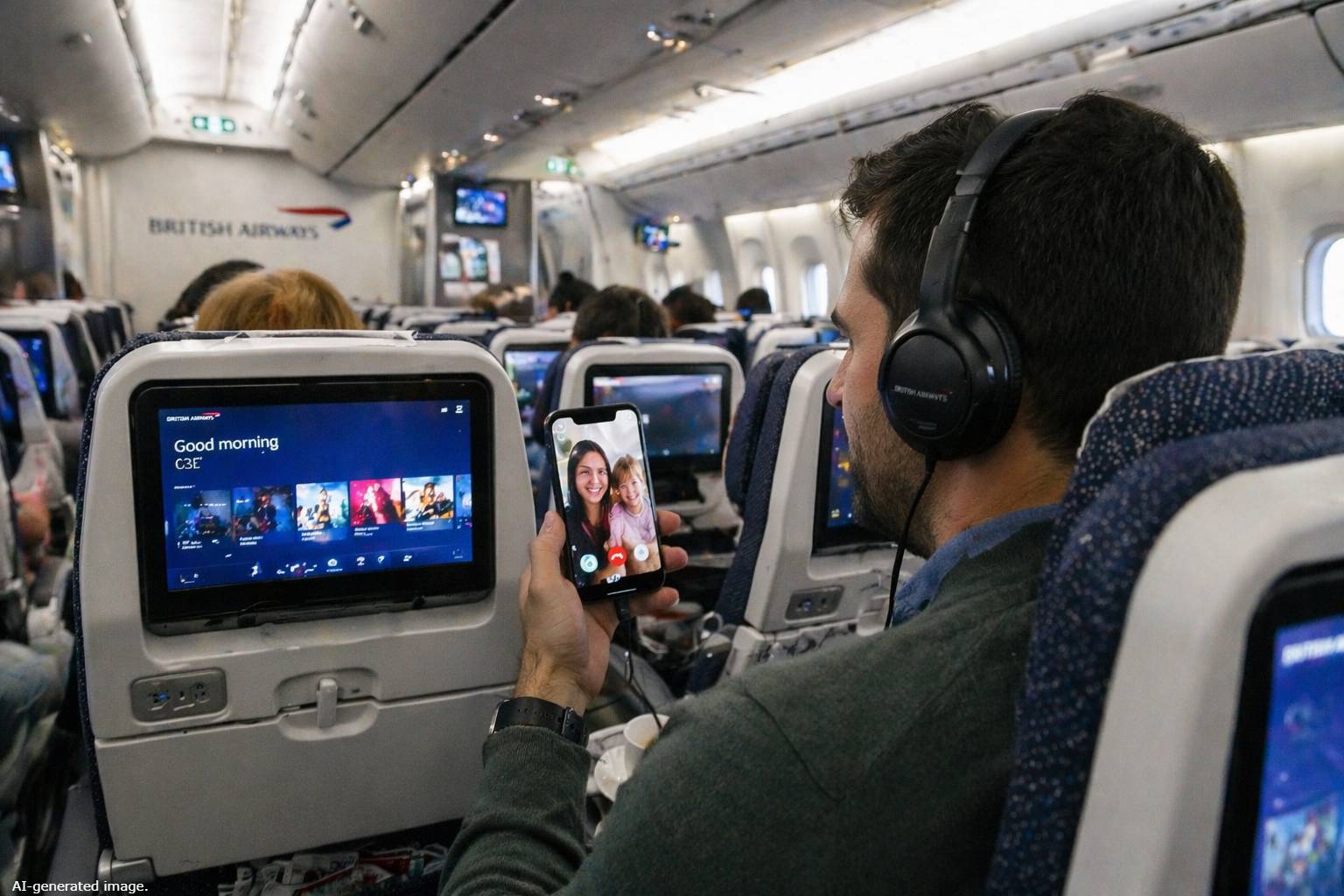

British Airways has been steadily upgrading its passenger experience, from expanding meet and assist services to rolling out high-speed Starlink WiFi across its fleet. The airline has now begun enabling in-flight voice and video calls on select aircraft, placing it alongside carriers such as Qatar Airways and Emirates that are advancing onboard connectivity.
British Airways In-Flight WiFi Calling: What Has Started
British Airways began offering Starlink-powered high-speed WiFi from 19 March 2026. On aircraft equipped with this system, passengers can access internet speeds capable of supporting:
- Voice calls through apps like WhatsApp and Teams
- Video calls via FaceTime or Zoom
- Streaming and real-time online activity
This is not a trial announcement. The service is already live on selected aircraft, although availability is still limited.
First Route and Rollout Plan
The first aircraft with this capability operated on the London Heathrow to Houston route, using a Boeing 787-8.
Current status:
- Available on a small number of aircraft
- Not tied to a specific route but to aircraft equipped with Starlink
Planned expansion:
- Installation across 300 plus aircraft
- Expected rollout period between 2026 and 2028
For India–UK travellers, this means the feature will gradually appear on routes such as Delhi, Mumbai, and Hyderabad to London as more aircraft are upgraded.
How Starlink Enables Mid-Air Video Calls
The technology behind this upgrade comes from SpaceX through its Starlink satellite network.
Key capabilities:
- High-speed internet comparable to home broadband
- Low latency required for uninterrupted voice and video calls
- Reliable connectivity across oceans and remote regions
Earlier in-flight WiFi systems supported messaging and limited browsing. Starlink enables consistent, real-time communication at cruising altitude.
How British Airways Compares to Other Airlines
British Airways is not alone in moving towards full connectivity, but adoption remains limited.
- Qatar Airways has already introduced Starlink connectivity with support for real-time communication
- Emirates has announced similar plans for fleet-wide upgrades
- Air France and Lufthansa are also progressing towards advanced satellite WiFi
However, most airlines still:
- Allow messaging and browsing
- Restrict or block voice and video calls
For example, United Airlines does not permit inflight voice or video calls. This places British Airways among a small group of airlines allowing broader onboard connectivity use.
What This Means for India–UK Travellers
For passengers flying between India and the UK, the impact will be gradual but meaningful.
Potential benefits:
- Attending work calls during long-haul flights
- Staying in touch with family through video calls
- Making better use of travel time
However:
- Availability depends on whether your aircraft is Starlink-equipped
- Not all flights currently offer this feature
Travellers should check aircraft details at the time of booking or before departure.
Passenger Experience and Cabin Etiquette
British Airways allows voice and video calls with basic guidelines:
- Keep conversations at a low volume
- Use headphones for all calls
- Be mindful of nearby passengers
The airline is balancing connectivity with comfort. The broader industry is still divided on whether cabins should remain quiet or become fully connected environments.
A Wider Shift in Air Travel
This development is part of a broader transformation at British Airways, including:
- Fleet-wide Starlink WiFi rollout
- Improved airport assistance and meet and assist services
- Upgraded premium cabins and digital experience
The airline is positioning itself as a connected, service-focused carrier.
British Airways has already begun enabling mid-air WiFi voice and video calls from March 2026, starting with select aircraft and expanding across its fleet over the next two years. While not yet available on all flights, the feature represents a clear shift in how airlines approach connectivity.
For India–UK travellers, this means the possibility of staying connected throughout the journey is no longer theoretical. It is gradually becoming part of the flying experience.