
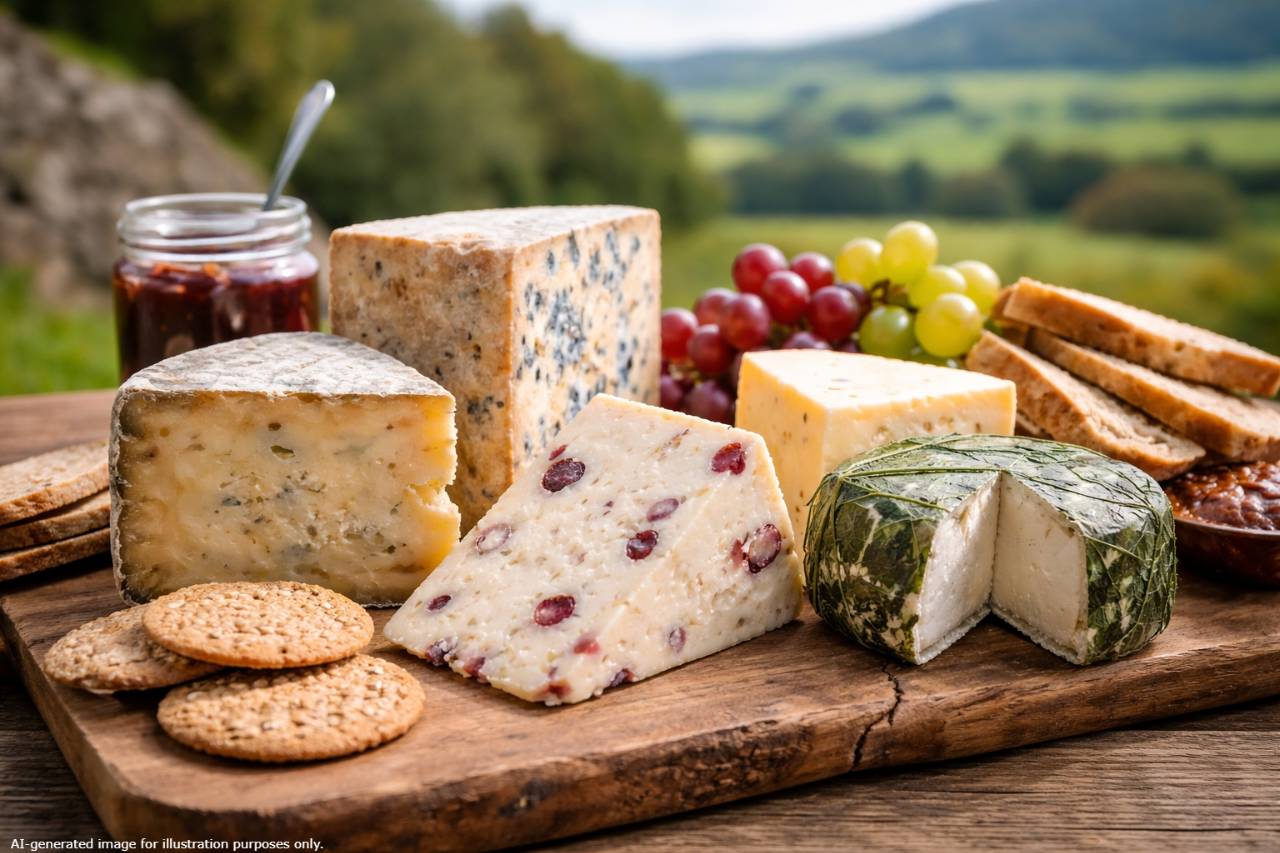

A food and travel guide for Indian travellers visiting Britain.
Quick guide for a short trip
Must-visit: Neal’s Yard Dairy in London (Covent Garden and Borough Market) — the easiest, richest introduction to British farmhouse cheese, and ideal as most Indian visitors base themselves in London. Book a guided tasting in advance: Neal’s Yard Dairy tastings.
Start with three cheeses: West Country Farmhouse Cheddar (Somerset), Wensleydale (Yorkshire), and Cornish Yarg (Cornwall) — three very different expressions of the British landscape.
Typical budget: £3–£6 per 100g for farmhouse cheese; £10–£20 for a cheese board in a pub. Prices as of June 2026.
Where to buy at a glance: farmers’ markets (cheapest and liveliest), independent cheesemongers (expert guidance and tastings), and farm shops (closest to the source). A full comparison is below.
Short on time or travelling without a car? See the half-day, train-only London plan under “Planning Your Route” below — it needs nothing but the Tube.
Vegetarian tip: ask about animal rennet. Wensleydale and Cornish Yarg are commonly vegetarian-friendly, and a good cheesemonger will check labels for you.
If you buy just one cheese — 20 minutes and £10
Buy a wedge of West Country Farmhouse Cheddar (PDO). It is the one cheese that is both unmistakably British and easy to find fast — any good supermarket, market stall, or cheesemonger will have it, so 20 minutes is plenty. Around £10 buys a generous 200g wedge.
One thing to check: the label must say “West Country Farmhouse Cheddar,” not just “cheddar.” Only the PDO version is the genuine, traditionally made article — plain “cheddar” can be made anywhere in the world.
Cheese in Britain is not just food — it is geography you can taste. As you move through the UK, cheese changes character with the land beneath your feet: grass, rain, wind, soil, and centuries of farming quietly shape what ends up on your plate. For Indian travellers this is an interesting shift. Back home, food often changes with spices and techniques; in Britain, it changes with landscape.
Somerset and Cheddar: tasting time, not sharpness
In Somerset, Cheddar tells the clearest story of place. The lush, moist pasture produces deep, full milk, and traditional Cheddar was matured in the cool limestone caves of Cheddar Gorge long before refrigeration existed. A proper cloth-bound Cheddar shows patience rather than intensity — firm, slightly crumbly, long on the palate. Look beyond supermarket Cheddar: ask a farm shop or cheesemonger for West Country Farmhouse Cheddar, which reflects real Somerset conditions and traditional methods.
Yorkshire and Wensleydale: a cheese for everyday life
Move north and the mood changes. Wensleydale reflects open valleys and softer landscapes — lighter and fresher, with a gentle acidity. Historically made by monks, it became a cheese for daily meals rather than ceremony. It breaks easily, melts reluctantly, and pairs naturally with fruit. For travellers it feels approachable, a little like the way paneer fits into Indian homes: familiar, useful, and quietly comforting.
Lancashire: shaped by working life
Lancashire offers a different northern character — young, crumbly, and milky, with a mild tang rather than sharpness. It grew up alongside industrial communities that valued nourishment and simplicity. Sometimes eaten fresh, sometimes aged, it slips easily into everyday meals and sandwiches, and you are more likely to meet it in pubs and local markets than tourist shops.
Cornwall and Cornish Yarg: where land meets sea
In the southwest, Cornwall’s cheeses feel touched by the sea. Cornish Yarg, wrapped in nettle leaves, develops a subtle earthiness that mirrors hedgerows and coastal lanes, its rind forming naturally rather than by design. It is a good reminder that British cheese often relies on natural ageing rather than spices or flavouring.
Wales and Caerphilly: practical food with purpose
Upland grazing gives Welsh cheeses a cleaner, more direct flavour. Caerphilly was once a working cheese for miners — moist, crumbly, and lightly tangy, designed to be eaten young and to sustain rather than indulge.
Northern Ireland: calm landscapes, balanced cheeses
In Northern Ireland, lush fields and steady rain create milk with natural sweetness, and the cheeses feel rounded and balanced rather than sharp. Traditional cheddars and modern farmhouse blues reflect a farming culture built on care and continuity.
Scotland and the southeast: climate shapes flavour
Scotland’s cheeses reflect cooler temperatures and harder ground; Highland blues feel sharp at first, then soften into balance. In contrast, the chalky soils of southeast England give fresh goat cheeses a clean, mineral edge — restrained and precise, much like the landscape itself.
Choosing where to buy: markets, cheesemongers, and farm shops
Each venue offers a different experience; the right choice depends on your budget, your time, and how close to the source you want to get.
| Where to buy | Typical price | Atmosphere | Time needed | Best for |
|---|---|---|---|---|
| Farmers’ markets | Lowest; cut to order | Lively, local, seasonal | ≈ 30 min | Trying several cheeses cheaply; go early |
| Independent cheesemongers | Mid to high; premium artisan | Calm, expert-led, samples | 30–45 min | Guidance, tastings, vegetarian (rennet) advice |
| Farm shops | Mid; closest to source | Rural, relaxed, tied to the land | Half a day with travel | Seeing where cheese is made; local pairings |
| Supermarkets | Lowest for everyday | Functional, convenient | 10–15 min | Budget basics and vacuum-packed gifts |
For a first stop on a short London-based trip, an independent cheesemonger such as Neal’s Yard Dairy gives the best balance of guidance, samples, and range. With a free day and a car, a farm shop or a course is the most memorable. Markets are perfect for grazing cheaply between sights.
What British cheese costs
- £3–£6 per 100g for traditional farmhouse cheeses
- £8–£15 for a small takeaway selection
- £10–£20 for a cheese board in a pub
- £20–£40 for premium artisan selections or gift boxes
Major supermarkets stock regional cheeses nationally — try Tesco or Asda for a standard selection, or Booths for a more specialised one. As a concrete example, a vegetarian cheese selection from Neal’s Yard Dairy costs £54.75 as of June 2026: Neal’s Yard Dairy vegetarian selection. Many cheesemongers also ship within the UK or arrange collection before you fly home.
How you know these cheeses are worth it
You don’t have to take this guide’s word for it. Most cheeses here carry an independent quality mark — either a UK protected food name (PDO or PGI), which legally restricts the name to traditional methods and a defined area, or a major award. The table links the official source for each, so you can verify before you buy.
| Region — cheese | Independent recognition | Verify |
|---|---|---|
| Somerset — West Country Farmhouse Cheddar | Protected Designation of Origin (PDO) | GOV.UK register |
| Yorkshire — Yorkshire Wensleydale | Protected Geographical Indication (PGI) | GOV.UK register |
| Wales — Traditional Welsh Caerphilly | Protected Geographical Indication (PGI), 2018 | GOV.UK page |
| Scotland — Orkney Scottish Island Cheddar | Protected Geographical Indication (PGI) | GOV.UK register |
| Cornwall — Cornish Yarg / Lynher Dairies | World Cheese Awards: Wild Garlic Yarg Super Gold; Cornish Kern, Supreme Champion 2017 | NFU report |
| Northern Ireland — Young Buck (Mike’s Fancy Cheese) | Best Blue Cheese in Ireland, Irish Cheese Awards 2024 | Maker’s page |
When shopping, look for the cheese’s full protected name on the label: “cheddar” alone is unprotected, but “West Country Farmhouse Cheddar” is the genuine PDO article.
Where to buy and book British cheese
To experience British cheese beyond supermarkets, specialist cheesemongers and food markets are the best places to start — they let you taste regional cheeses, speak directly with experts, and find producers that rarely appear on supermarket shelves.
Do you need to book ahead? Walking into a shop to browse and buy does not require a booking. But guided tastings, cheese-and-wine evenings, and full-day cheese-making or certification courses almost always sell out and must be booked in advance — especially at weekends. If a tasting or course is part of your plan, reserve it before you travel using the links below.
London — Neal’s Yard Dairy (our must-visit)
Covent Garden: 17 Shorts Gardens, London WC2H 9AT · Mon–Wed 11:00–18:00, Thu–Sat 10:30–18:30, Sun 11:00–17:00.
Borough Market: 8 Park Street, London SE1 9AB · Mon–Fri 9:00–17:00, Sat 8:00–17:00, Sun 10:00–17:00.
One of Britain’s most respected cheesemongers and a superb introduction to artisan British cheese, sourced directly from farmhouse producers across the UK. Book a guided tasting: Neal’s Yard Dairy tastings (in-person and virtual; reserve ahead). General shop and website: Neal’s Yard Dairy.
On arrival & getting there: Covent Garden is the calmer of the two — ask for a three-cheese flight and vegetarian (vegetarian-rennet) options; Borough is excellent but very busy on Saturdays, so visit on a weekday morning. Both are fully walkable from public transport — Tube to Covent Garden/Leicester Square, or London Bridge for Borough. No car needed.
Somerset — Bath Farmers’ Market
Green Park Station, Bath BA1 1JB · Every Saturday 9:00–13:30 (year-round).
Established in 1997, the UK’s first farmers’ market and an excellent place to find West Country Farmhouse Cheddar. Drop-in, no booking needed.
On arrival & getting there: busiest 10:00–11:00, so come close to 9:00 for full choice; ask for a taste and look specifically for PDO West Country Farmhouse Cheddar. A 10-minute walk from Bath Spa station (about 1.5 hours by train from London Paddington).
Yorkshire — The Courtyard Dairy
Crows Nest Barn, Austwick, near Settle, North Yorkshire LA2 8AS · Mon–Sat 9:30–17:30, Sun 10:00–17:00.
One of Britain’s best-known specialist cheese shops, with a small cheese museum and a café. Book a cheese-making course (≈ £140, full day, up to 8 people): The Courtyard Dairy courses — roughly monthly and quick to fill, so book well ahead.
On arrival & getting there: rarely crowded, with free parking; ask staff for their current pick of the counter. Reachable without a car — trains to Clapham (about 2 miles) or Settle (about 5 miles), then a short taxi. A rural day trip, not a quick add-on.
Wales — Cardiff Central Market & Castle Arcade
St Mary Street, Cardiff CF10 1AU · Mon–Sat 8:00–17:30, closed Sundays.
A historic Victorian market; head to The Cheese Stall for a strong range of Welsh cheeses including Caerphilly. Drop-in, no booking. For a tasting experience, the award-winning Tŷ Caws runs a cheese-and-wine bar and bookable events a few minutes away in Castle Arcade.
On arrival & getting there: busiest around Saturday lunchtime; ask for Traditional Welsh Caerphilly (PGI) cut to order. About an 8-minute walk from Cardiff Central (roughly 2 hours by train from London Paddington).
Cornwall — Truro farm shops and cheesemongers
Many Cornish producers sell directly around Truro — often the best way to discover authentic Cornish Yarg.
Lynher Dairies — The Cornish Yarg Cheese Shop: Ponsanooth, Truro TR3 7JQ · Mon–Fri 9:00–17:00, Sat 9:00–15:30, closed Sun. The working dairy and farm shop where Cornish Yarg is made — the place to taste it at source. Website: Lynher Dairies. (Drop-in farm shop with free parking; no public factory tour.)
The Cornish Cheesemonger: Unit 69, Truro Pannier Market, Back Quay, Truro TR1 2LL · Tue–Sat 9:00–17:00. Over one hundred speciality cheeses, many from Devon and Cornwall. Website: the Cornish Cheesemonger.
On arrival & getting there: quiet and relaxed — ring ahead in winter for shorter hours; ask for Cornish Yarg and spring-only Wild Garlic Yarg (both vegetarian). Central Truro is walkable from Truro station (about 4.5 hours from London Paddington); a car helps for the farm shop.
Scotland — I.J. Mellis Cheesemongers, Edinburgh
30 Victoria Street, Edinburgh EH1 2JW · Mon–Sun 10:00–18:00.
Just off the Royal Mile, Scotland’s best-known artisan cheesemonger, maturing farmhouse cheeses from across Scotland and the UK; staff will vacuum-seal for travel. Tastings run at its Cheese Lounge — see I.J. Mellis and book ahead. For wider producers, the Scottish Cheese Trail lists makers.
On arrival & getting there: Victoria Street gets busy on weekend afternoons; ask for a Scottish flight — a Highland blue and an Orkney Scottish Island Cheddar (PGI) make a good contrast. A 10-minute walk from Edinburgh Waverley.
Northern Ireland — Maegden, Bushmills
119 Main Street, Bushmills, County Antrim BT57 8QB · Wed–Sat 9:30–17:30, Sun 10:00–16:00 (hours vary seasonally).
In the north-coast village of Bushmills, a short hop from the Giant’s Causeway, Maegden is a proper cheesemonger and deli championing small-batch Irish and British farmhouse cheeses, with coffee and famous grilled-cheese toasties.
On arrival & getting there: a small, friendly shop, busiest at weekend lunch; ask for Northern Irish cheeses such as Young Buck blue. Reachable car-free — train to Coleraine, then the 172 or 402 bus to Bushmills, which continues to the Giant’s Causeway.
Planning your route: by car or by train
A full British cheese tour is not a single day out — the regions span the whole country, so most visitors pick one base (usually London) plus a day trip or two. All the London venues, Bath, Cardiff, and Edinburgh’s I.J. Mellis are a short walk from a main station; The Courtyard Dairy and the Cornish farm shops are train-plus-taxi; Maegden is train to Coleraine then a bus.
If you only have a few hours: a half-day London plan (no car)
The most efficient option for a time-poor visitor — nothing but the Tube and your feet. Book the Neal’s Yard tasting ahead if you want the guided version.
| Time | Stop | What to do |
|---|---|---|
| 10:30 AM | Neal’s Yard Dairy, Covent Garden | Browse and taste; ask for a three-cheese flight and vegetarian options (≈ 45 min) |
| 11:30 AM | Walk / Tube to London Bridge | About 25 minutes door to door |
| 12:00 PM | Neal’s Yard Dairy, Borough Market | See the bigger counter; buy a vacuum-packed wedge to take home (≈ 45 min) |
| 1:00 PM | Lunch at Borough Market | A cheese toastie or a pub cheese board nearby (£10–£20) |
Going further: rough train times from London
| Destination | From London by train (approx.) | Cheese stop |
|---|---|---|
| Bath Spa | 1 hr 30 min | Bath Farmers’ Market (Saturdays) |
| Cardiff Central | 2 hr | Cardiff Central Market + Tŷ Caws |
| Settle / Clapham (N. Yorks) | 3 hr + short taxi | The Courtyard Dairy |
| Truro | 4 hr 30 min | Cornish Yarg country |
| Edinburgh Waverley | 4 hr 30 min | I.J. Mellis |
| Bushmills (via Belfast + Coleraine) | Fly to Belfast, then train + bus | Maegden |
The core territorial cheeses — West Country Farmhouse Cheddar, Wensleydale, Caerphilly, and Cornish Yarg — are made and sold year-round, so any season works. A few specialities are seasonal (Wild Garlic Yarg appears mainly in spring), and rural farm shops keep shorter winter hours, so spring through autumn is the most reliable window for a multi-stop trip.
Frequently asked questions
Is British cheese vegetarian? Some are; others use animal rennet. Wensleydale and Cornish Yarg are commonly vegetarian-friendly, and several cheddars carry official vegetarian certification — always check the label or ask a cheesemonger.
Do I need to book tastings or courses in advance? Yes. Shop visits are drop-in, but guided tastings, cheese-and-wine evenings, and cheese-making or certification courses are limited in size and routinely sell out, especially at weekends. Reserve before you travel using the links above.
Can I bring British cheese back to India? Regulations change, so check current Indian customs and your airline’s rules before travelling. Vacuum-packed cheese is easier to carry than fresh, unpackaged varieties; keep receipts, and pack it in your checked baggage.
Can I do a cheese trip without renting a car? Yes. The London venues, Bath, Cardiff, and Edinburgh’s I.J. Mellis are all a short walk from a main station; The Courtyard Dairy and the Cornish farm shops are train-plus-taxi; Maegden is train to Coleraine then a bus. A car only saves time for the rural stops.
How much should I budget, and when should I go? Expect £3–£6 per 100g for quality farmhouse cheese and £10–£20 for a pub cheese board. The main cheeses are available all year, so timing is flexible, though spring to autumn suits a multi-stop trip best.
Tasting geography, one bite at a time
If you have only a few days, start with three cheeses — West Country Farmhouse Cheddar in Somerset, Wensleydale in Yorkshire, and Cornish Yarg in Cornwall — for three very different expressions of the British landscape. Carry an insulated bag in warmer months, visit on weekdays when staff have more time, and let cheese guide you quietly through the country. The land speaks through milk, and if you pay attention, you begin to understand Britain in a new way.