
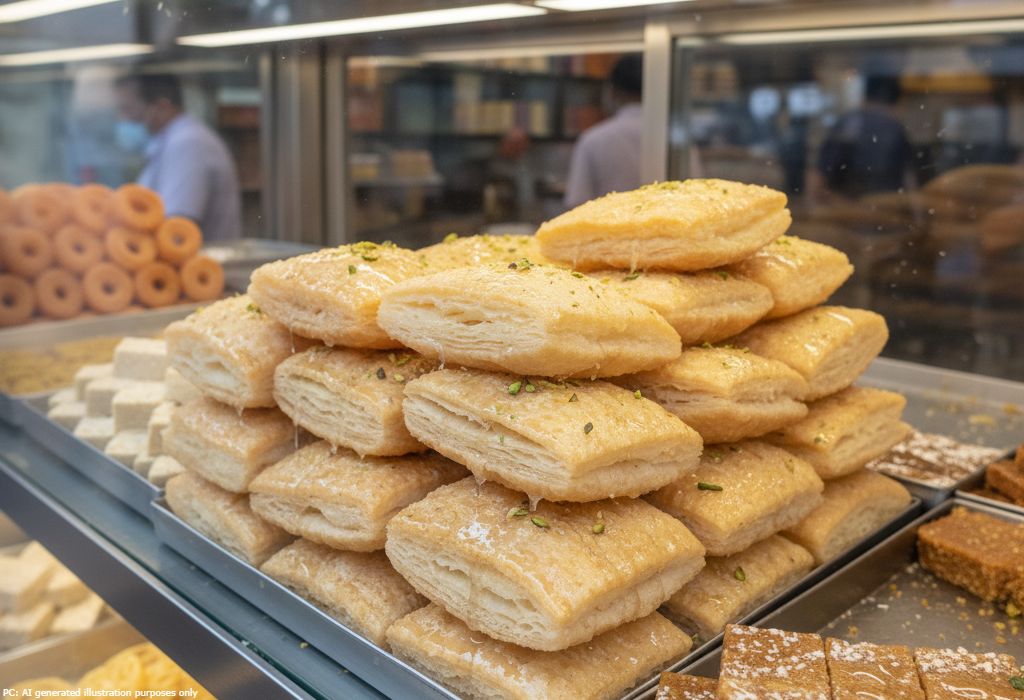

Khaja has been getting global attention after it appeared on the TasteAtlas list of best sweet pastries, making news across India and abroad. Food travellers, chefs and even local governments celebrated the recognition because khaja is not just a dessert. It is an ancient, multilayered Indian pastry with roots in temple kitchens, royal courts and old trade routes. When you taste it during your trip to India, you discover a sweet that is crisp, golden, syrupy inside and full of stories.
What is Khaja sweet and what does it taste like?
Khaja is a layered pastry made by rolling thin sheets of dough, stacking them with ghee, then deep frying them until the layers puff up. Some versions are soaked lightly in sugar syrup while others are simply glazed. The first bite gives you a crisp snap, followed by a soft centre that feels almost honeyed. Many travellers compare it to baklava or millefeuille, but it has its own Indian identity with gentle cardamom flavour, ghee aroma and a balanced sweetness.
How old is Khaja and where did it come from?
Khaja is linked to the ancient Magadh region in eastern India. Several cultural studies and historical notes mention that layered sweets existed here more than 2,000 years ago. During British archaeological work in the 1870s, researchers recorded sweets similar to khaja in villages around Silao in Bihar. In Odisha, khaja became part of temple tradition, especially in the Jagannath Temple of Puri, where it is included in the sacred chappan bhog. This connection with daily offerings and festivals helped the sweet survive through centuries.
The old recipe changed across regions as local cooks added their own techniques. That is why a traveller today finds different shapes and textures, each with its own flavour story.
Why is Khaja in the news today?
Khaja has been highlighted on the TasteAtlas ranking of top Indian pastries, which reached international food discussions. Many travel and food publications recently wrote about khaja from Odisha and Bihar because of this renewed interest. The recognition also boosted tourism around places like Puri and Silao, where travellers go specifically to taste the authentic versions.
Along with this, Silao Khaja from Bihar received a Geographical Indication tag in 2018, which protects its unique method and ingredients. The GI tag helps travellers identify the genuine product and encourages local makers to preserve traditional techniques.
Where can you try authentic Khaja in India?
India has three major khaja regions, each offering a different experience.
Silao Khaja, Bihar
Silao in the Nalanda district is famous for ultra thin, crisp layers that melt softly after you bite into them. This version is very light, mildly sweet and made with great care, often by families who have followed the same method for generations. The GI tag recognises its cultural value. Travellers visiting Nalanda, Rajgir or Bodh Gaya often buy Silao khaja as a gift because it keeps well and tastes fresh for several days.
Kakinada Kaja, Andhra Pradesh
Kakinada and the coastal belt of Andhra offer a very different style. Here you find two famous types: gottam kaja, which is a hollow cylinder with a sugary interior, and madatha kaja, which has folded layers. These versions are usually slightly syrupy inside and firm outside. Locals proudly talk about recipes dating back to the late nineteenth century. If you enjoy sweets with a strong crunch and a sweet middle, Kakinada kaja is the best choice.
Puri Khaja, Odisha
Puri’s khaja is deeply connected to temple food culture. It is part of the offerings at the Jagannath Temple and is often sold fresh around the Grand Road near the temple. Odisha’s khaja is crisp, glossy and less layered than the Silao version, but it has a unique flavour because of the sugar syrup method used here. Many shops still follow the traditional practice of resting the khaja on sal leaves while preparing it, which some locals say adds aroma. Puri khaja also attracted global curiosity after TasteAtlas listed it among India’s best pastries.
What are the different names and variants of Khaja?
Across India, khaja appears under names like khaja, kaja, kaaja and khajuri. Each region has its own spelling and slight recipe change. Silao Khaja uses very thin layers and minimal syrup. Kakinada Kaja uses thicker dough, tubular shapes and more sweetness inside. Puri Khaja uses a crisp outer layer with a shiny finish. If you travel through Bihar, Odisha and Andhra on the same trip, you will taste three sweets that share the same idea but feel entirely different.
Why should British travellers try Khaja sweet?
Khaja is a perfect introduction to India’s regional dessert culture. It is light, not overly sugary and very travel friendly. The flavour profile is familiar enough for European tastebuds, yet different enough to feel like a discovery. Since many versions are dry or lightly syruped, they pack easily into a small box, which makes them ideal souvenirs to take home.
For travellers who love exploring food with history, khaja is a sweet that connects you with ancient kingdoms, coastal trade, temple rituals and local pride.
Tips for buying Khaja during your trip
- Choose fresh batches. Morning batches taste best and remain crisp longer.
- Ask locals. They will guide you to the most trusted sweet shops.
- Pick the right style. Try dry khaja if you like crisp pastries. Choose syrup filled ones if you enjoy soft, melt in the mouth centres.
- Check packing. Ask for a sealed box if you plan to carry it on a train or flight. Dry versions travel better than syrup soaked ones.
- Avoid overly oily pieces. Authentic khaja tastes light and fragrant.
How does khaja compare to pastries you may already know?
Many travellers describe Silao khaja as an Indian cousin of millefeuille because of its layered texture. Others compare Puri khaja to light baklava because of the syrup. Kakinada kaja is often compared to a sweet croissant roll with syrup inside. These comparisons help British travellers understand the texture, but once you try the real thing you notice its identity is unmistakably Indian.
Can you bring Khaja back to the UK?
Yes, you can carry commercially packaged khaja while returning from India. Check the latest UK customs rules, but most dry sweets without dairy filling are allowed. Always pack dry versions for safety, avoid heavily syruped pieces and keep the box upright during your flight.
Why khaja deserves a place on your India food list
Khaja is one of those sweets that look simple but carry centuries of history and regional pride. It is a dessert that travelled through kingdoms, temple kitchens and family traditions, yet still feels fresh and comforting today. With global recognition through platforms like TasteAtlas and local protection through the GI tag, the sweet is finally receiving the attention it deserves.
When you walk through the lanes of Puri, Silao or Kakinada, stop for a box of fresh khaja. You will not just taste a pastry. You will taste a piece of India’s culture, craft and everyday joy.